The first article of the year and the penultimate article in my nutrition series focuses on Vitamins.
What are vitamins and what do I need them for?
Vitamins are a group of organic compounds that are vital for sustaining life of organisms. Any compound that cannot be produced by the body in sufficient quantities are labelled vitamins. So this means that some vitamins aren't vitamins to other animals, Vitamin C is a prime example. In a well constructed balanced diet the body gets all the required vitamins from the food consumed, however supplementation is sometimes need, like in people with low Vitamin B-complex or in countries which suffer long periods of darkness and thus less Vitamin D absorption. As they are chemically based, they can be produced synthetically.
There are currently 13 worldwide recognised vitamins and the human body needs a certain amount of all of these in other to help growth and strength of bones, skin and hair, protection from diseases and many other functions.
Vitamin A
Vitamin A is important for the development of children, resisting infection and helping eyesight, especially night vision. It is found within fatty foods and those foods containing carotene, like carrots. Dark green vegetables are also high in Vitamin A as they contain high concentrations of carotene which is masked by the greenness. Fish liver oils normally contain the most Vitamin A per gram. Diary products also contain Vitamin A but the amount varies on numerous factors, the Summer months are normally the best for Vitamin A as the cattle graze on fresh forage Foods containing Vitamin A should be stored in low-non light conditions and in cool, dry areas as carotene is destroyed by light.
Taking too much Vitamin A can result in Hypervitaminosis A. This can cause problems with skeletal development and with vitamin metabolism, as well as other minor ailments. However, unless you are a child or elderly, then the chances of overdosing on Vitamin A are slim.
Vitamin B
Vitamin B was originally thought to be just one substance but further research has found that it can be broken down into eight individual substances. The three main ones are Thiamin (B1), Riboflavin (B2) and Nicotinic acid or Niacin (B3). It is used by the body for maintaining of the nervous system, allowing the body to process carbohydrates and break them down for energy and encouraging growth. It should also be noted that Vitamin B is water soluble and so it can be lost during cooking, high temperatures and bicarbonate of soda also destroy Vitamin B. Riboflavin is quite resistant to high temperatures but bright sunlight (or equivalent) will result in it breaking down. Good sources for Vitamin B are grains, pulses, beans, potatoes, bananas, tuna, turkey and liver.
There are various side effects from being deficient or overdosing on Vitamin B ranging from sore throat and rashes to mania and neurological damage. However, most people within the Western World get enough Vitamin B within their daily diet without the need to add more.
Vitamin C
Vitamin C is an antioxidant and is produced internally by many organisms, however Humans is not one of them. It is essential that Humans get enough Vitamin C in their diet as it is needed for child development, helping the healing of the body and fighting diseases especially in mouth and gum infections. Vitamin C can be lost when cooking or soaking in water, also never use bicarbonate of soda when cooking vegetables or fruits. Also bad storage will reduce the amount of Vitamin C in a product, length of time, bad ventilation, too warm and bruising are the main causes. Also be careful of cutting your vegetables and fruits into too small pieces as this will effect the Vitamin C levels.
Generally the majority of our Vitamin C comes from plant based sources. Even though the exact amount varies depending on climate it was grown in, soil it was planted in, when it was picked, how it was stored etc, some of the better sources are oranges, tomatoes, lemons, limes, grapefruit, seabuckthorn and chillies. As most animals synthesize their own vitamin C, it stands to reason that we can gather sources of Vitamin C from animal products. It is most present within the liver but as most of the meat sources we use in our diet are from the muscle, it means we shouldn't rely on it for our Vitamin C intake. The best sources for animal based Vitamin C is calf liver, beef liver, raw oysters and cod roe. Basically any offal is a source of Vitamin C but it is greatly reduced in comparison to plant based sources.
On a side note, the nickname for British, Limeys, comes from the days of the 19th century. The Royal Navy added lime juice to the sailor's daily ration of watered down rum (known as grog) so it would make the stored, stagnant water more palatable. This had the added effect of starving off scurvy (a side effect of too little Vitamin C) and making the Royal Navy sailors to healthiest in the world.
Vitamin D
Vitamin D is a very important vitamin for ourselves. Without it, our body's would start lacking from calcium which is important for our bones and teeth. The biggest source for Vitamin D is sunlight, as much as 75% of our Vitamin D comes from our exposer to sunlight. Very few foods contain Vitamin D and so it is important that people get out in the light. Lack of Vitamin D causes problems such as rickets and depression. The majoirty of people get enough natural light that a deficiently isn't a problem but in countries above the 60th parallel (Nordic, Provinces in Canada, parts of Russia etc.) then alternatives are needed, some of these come in the form of tablets or special lights.
The best foods that do contain sufficient amounts of Vitamin D are fish-liver oils, oily fish (Salmon, Tuna, Herring, Sardines etc.) egg yolks and some dairy products. Vitamin D is a very hardy substances and so isn't lost during cooking.
Vitamin E
Vitamin E is a lesser known vitamin and is mainly used by our bodies as an antioxidant, it also helps muscle growth and neurological function. As it is fat soluble, it is found mainly within oils like Sunflower, Wheat Germ, Nut and Olive. It is very rare to not get enough Vitamin E, however when it happens it has been linked to sterility and anaemia.
Vitamin K
Vitamin K is another lesser known vitamin and is used to help process proteins for blood coagulation, and to a lesser extant, to help bind calcium to bones. Without sufficient amounts of Vitamin K, the body can find itself with uncontrolled bleeding, weakened bone and calcification of soft tissues, like arteries.
Vitamin K is find within green vegetables, mainly kale, spinach, Brussels spouts and cabbage. It can also be found within mature cheeses and chicken liver.
Showing posts with label Nutrients. Show all posts
Showing posts with label Nutrients. Show all posts
Friday, 16 January 2015

Thursday, 23 January 2014
Fats
For this weeks nutrition related article I though about tackling one of the two (the other being Carbohydrates) most commonly confused nutritional elements.
What is Fat?
Fats are a group of compounds that are generally insoluble in water and are needed for processing certain vitamins and minerals (See below). There are many categories and divisions of fats, firstly they can be put into two initial groups; Solid Fats, which are solid at room temperature, and Oils, which is a liquid at room temperature. They can be divided further, which we will look into, like saturated fats, trans fats etc.
What is the confusion?
The main source of the confusion about fats mainly comes from the name. People see the word FAT and automatically equate it to that belly and increasing waistline. Of course there is some truth in that but all nutrients are involved in that, as was mentioned in the first article, the importance is balance. For starters Vitamins A, D, E and K need fat to be processed and absorbed into the body's system. Fats are also important in containing fatty acids (in fact fat is composed of glycerol and three fatty acids, that is why the chemical name is triglyceride), that are essential for our daily diet (but I will go more in Fatty Acids on a different article).
Some myths that I have found throughout the internet and from my life as a Chef in regards to Fat are the following:
 |
| A delicious array of cheese. |
What is Fat?
Fats are a group of compounds that are generally insoluble in water and are needed for processing certain vitamins and minerals (See below). There are many categories and divisions of fats, firstly they can be put into two initial groups; Solid Fats, which are solid at room temperature, and Oils, which is a liquid at room temperature. They can be divided further, which we will look into, like saturated fats, trans fats etc.
What is the confusion?
The main source of the confusion about fats mainly comes from the name. People see the word FAT and automatically equate it to that belly and increasing waistline. Of course there is some truth in that but all nutrients are involved in that, as was mentioned in the first article, the importance is balance. For starters Vitamins A, D, E and K need fat to be processed and absorbed into the body's system. Fats are also important in containing fatty acids (in fact fat is composed of glycerol and three fatty acids, that is why the chemical name is triglyceride), that are essential for our daily diet (but I will go more in Fatty Acids on a different article).
Some myths that I have found throughout the internet and from my life as a Chef in regards to Fat are the following:
- Less Fat means weight loss. This isn't entirely true, in fact according to figures obesity rates have soared by 20% in the last 10 years (the same time that the low-fat revolution has been active). The key to weight loss is by managing calories, fats can help this because they are filling and thus make it easier to avoid over eating.
- All fats are the same. Another big myth, fats have differing values depending on their structure. Also it is scientifically researched that Saturated and Trans Fats are worse for you when taken in excess than mono-unsaturated and polyunsaturated. However all fats taken in excess cause problems and all intakes should be taken into account by your age, weight and activity.
- Eating Fat-Free is better. This is so not true that it hurts me so much to see health nuts proclaim it as such. Fat-Free foods normally contain higher concentrations of sugar, refined carbohydrates and calories. Don't think so? Just check next time you go to the markets.
So what is recommended in your diet for fat? Well according to food scientists, about 20-30% of your calories should come from fats however to break this down further it is recommended that no more than 10% should be Saturated fats and no more than 1% come from Trans fats.
However we shouldn't get too scared by all this and start trying to have no fat in our life. If we look at something foodies call the French Paradox we can see that having a lifestyle high in saturated fats doesn't mean you will have a heart attack. It is all about how you eat, all comes down to the magical word BALANCE. If we took the time to just go out for a walk 30 minutes a day, our body would function a whole lot better. If we ate more greener, stable, vitamin rich foods our body would perform harder, better, faster, stronger (That was deliberate for those who get it). So think about your lifestyle and its needs when planning your meals.
Sources of Fats
Here is a list of some sources of fats and what kinds they are:
Monounsaturated Fats
- Olive oil
- Sunflower oil
- Peanut oil
- Sesame oil
- Avocados
- Olives
- Nuts (mainly peanuts, almonds, macadamia, pacans, cashews and hazelnuts)
- Peanut butter
Polyunsaturated Fats
- Soybean oil
- Corn oil
- Walnuts
- Tofu
- Fatty Fish (Salmon, Herring, Trout, Tuna, Sardines and Mackerel)
- Soy Milk
- Seeds (Sunflower, Flax, Pumpkin and Sesame)
Saturated Fats
- Red Meats, especially the high fat cuts (Chops,Rib-Eyes, Tenderloin, Shoulder)
- Chicken with the skin
- Ice Cream
- Lard
- Butter
- Whole-fat Diary (Milk and Cream)
- Palm and Coconut oil
Trans Fats
- Cheap and Stick Margarines (also commonly know as Baking Margarine)
- Snack Foods (Popcorn, microwave Burgers and Hotdogs, Crisps)
- Vegetable Shortening (Crisco)
- Fried Foods
- Commerically baked products (Doughnuts, Pizzas, Muffins, Cakes)
- Sweets
 |
| Home made Peanut Butter. |
What does our body use it for?
Fats have the important job of helping our skin and hair remain healthy. People who suffer from skin and hair conditions are normally advised to take foods that contain higher concentrates of fats, like nuts, seafood etc. It also provides cushioning for our organs against shock (not as in boo you scared the living day lights out of me kind of shock), regulation of our body temperature (which is why I can currently stand this -20oC plus Finnish Winter) and helping the cells in our body stay healthy and perform their tasks.
Fat is also an emergency energy store, each gram contains around 37 kilojoules (8.8 kcal/g). During the digestion process the fats are broken down into glycerol and fatty acids. The glycerol is turned into glucose by the liver and stored for energy.
Another very important but very unheard of duty for Fats is in the helping the body against diseases. When the body realises that a substance, chemical or biotic, starts reaching unsafe levels it essentially dilutes it into new stored fat tissue. This protects the organs from the substances and eventually the body removes it by the metabolising, sweating, urination, hair growth and sebum excretion (this is an oily, waxy substance the body excretes to help the skin and hair stay healthy).
It is impossible, and indeed unwise to try, to remove all fats from your diet. To do so would neglect the body of essential nutrients that would lead to several serious conditions. The essential fat (needed to maintain body functions and thus life) percent for a human body is 2%-5% for Men and 10%-13% for Women. For a healthy lifestyle men should have an overall body fat % of 8%-19% in under 40's and 11%-21% for over 40's. Women should have 21%-32% for under 40's and 23%-33% for over 40's. Having over 25% for Men and over 35% for Women is considered obese.
Effects of cooking on Fats
There is little effect on fats from cooking other than to make it more digestible.
We could go on and on about Fats and the pros and cons, but I believe that what is currently wrote here will do for now. Maybe in the future I will go more into detail on fats and each type.
Thursday, 16 January 2014
Proteins
So for us to have a better understanding of nutrition we need to have more information on the nutrients and what there functions are. So today I will be writing about Proteins, 'Why proteins first?' you ask, well no particularly reason I just thought to start at this one.
What is Protein?
Protein is an essential part of every living things. It is composed of different amino-acids in one or more chains. These chains perform a massive array of functions within the body and are very essential, many of these amino-acids need to be provided by food. When a protein contains all the essential amino-acids in the correct proportion are said to be of high biological value.
There are two kinds of proteins:-
What does our body use it for?
Proteins are essential for the growth and repair of the body tissues. It can also be use as a fuel source if the body is running low on carbohydrates and lipids. It is important that children, expectant and nursing mothers get more protein than other adults. You can go over on your protein intake, it will be used for energy and fuel. However continual excessive consumption of protein can lead to kidney stones and liver related problems.
The minimum recommended intake of protein is:-
What is Protein?
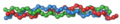 |
| A collagen triple helix. Source: Wikipedia |
Protein is an essential part of every living things. It is composed of different amino-acids in one or more chains. These chains perform a massive array of functions within the body and are very essential, many of these amino-acids need to be provided by food. When a protein contains all the essential amino-acids in the correct proportion are said to be of high biological value.
There are two kinds of proteins:-
- Animal Protein. This is obviously found in meat, game, poultry, fish, eggs, milk and cheese. Some of these proteins names collagen, myosin (meat, poultry and fish), albumin, ovoitellin (eggs), and casein (milk and cheese).
- Vegetable Protein. Most of these proteins are found in the seeds of vegetables. Greent and Root vegetables have a low proportion of protein compared to their weight. Peas, beans and nuts have a higher value and contain the most amount of protein, however not necessarily of high biological value. Cereals such as wheat, are very good because of the amount eaten in a typical sitting. Some of these protein names are gliadin, glutenin.
What does our body use it for?
Proteins are essential for the growth and repair of the body tissues. It can also be use as a fuel source if the body is running low on carbohydrates and lipids. It is important that children, expectant and nursing mothers get more protein than other adults. You can go over on your protein intake, it will be used for energy and fuel. However continual excessive consumption of protein can lead to kidney stones and liver related problems.
The minimum recommended intake of protein is:-
- 0.75 grams per kilo Adult Female
- 0.84 grams per kilo Adult Male
- 1 gram per kilo for expectant and nursing mothers
Effects of cooking on protein
When proteins are heated they coagulate (set) at different temperatures, when they go over their setting temp shrinkage occurs. This is most noticeable when grilling or roasting meats. Protein is easier to digest when it is moderately cooked rather than under or over cooked, as is most common with many households.
Thursday, 9 January 2014
Nutrition: The Key to a Healthy Body
Over the next few weeks I will write several articles based on nutrition. In every catering course (to my knowledge) there is classes on basic nutrition and food science with options to go more in-depth. Nutrition is one of the most important things for our bodies and yet many people are either confused or lack the knowledge about it.
So what is Nutrition?
Nutrition is the breaking down (digestion) of materials from foods to provide energy and heat, for repair and growth and help regulate the body. In nutrition (the study of nutrients) a food is any substance, a liquid or solid, which provides the body with one or all of the things mentioned above. Most foods contain several nutrients but some foods, like sugar, contain only one nutrient.
If more people knew about and practised good nutrition, then many of the health problems that inhibit thousands of people in the world could be avoided.
There are six main classes of nutrients and these are: Carbohydrates, Fats, Proteins, Vitamins, Minerals and Water.
So what is Nutrition?
Nutrition is the breaking down (digestion) of materials from foods to provide energy and heat, for repair and growth and help regulate the body. In nutrition (the study of nutrients) a food is any substance, a liquid or solid, which provides the body with one or all of the things mentioned above. Most foods contain several nutrients but some foods, like sugar, contain only one nutrient.
If more people knew about and practised good nutrition, then many of the health problems that inhibit thousands of people in the world could be avoided.
There are six main classes of nutrients and these are: Carbohydrates, Fats, Proteins, Vitamins, Minerals and Water.
 |
| The main function of nutrients |
Digestion
Digestion is the chemical and mechanical breakdown of foods into smaller elements for ease of absorption. There are three main areas in which this takes place:
- In the mouth where a mechanical action starts by breaking the food into smaller pieces and saliva is introduced to the food and the starch is broken down by an enzyme in the saliva.
- The stomach is next. In here a chemical action takes place where the gastric juices are added and proteins are broken down. At the same time a mechanical actions is going on where the muscles of the stomach are contracting, thus mixing the food to help the digestive enzymes.
- After passing from the stomach, the food enters the small intestine. Here proteins, fats and carbohydrates are digested further and absorbed into the blood. 95% of the absorption of nutrients happens here.
In the large intestine water and minerals are re-absorbed from the waste products. Bacteria in the large intestine produce vitamins, noticeably biotin and vitamin K, and these are absorbed into the blood as well.
 |
| Source: Wikipedia |
For the body to fully benefit from foods it is very important to stimulate the flow of saliva and gastric juices. This can only be achieved if the food looks, smells and tastes good. If one of these factors is not met then the digestive process is not acting at 100%. This, as well as lacking in one or more nutrients, leads to a state of malnutrition.
Subscribe to:
Posts (Atom)